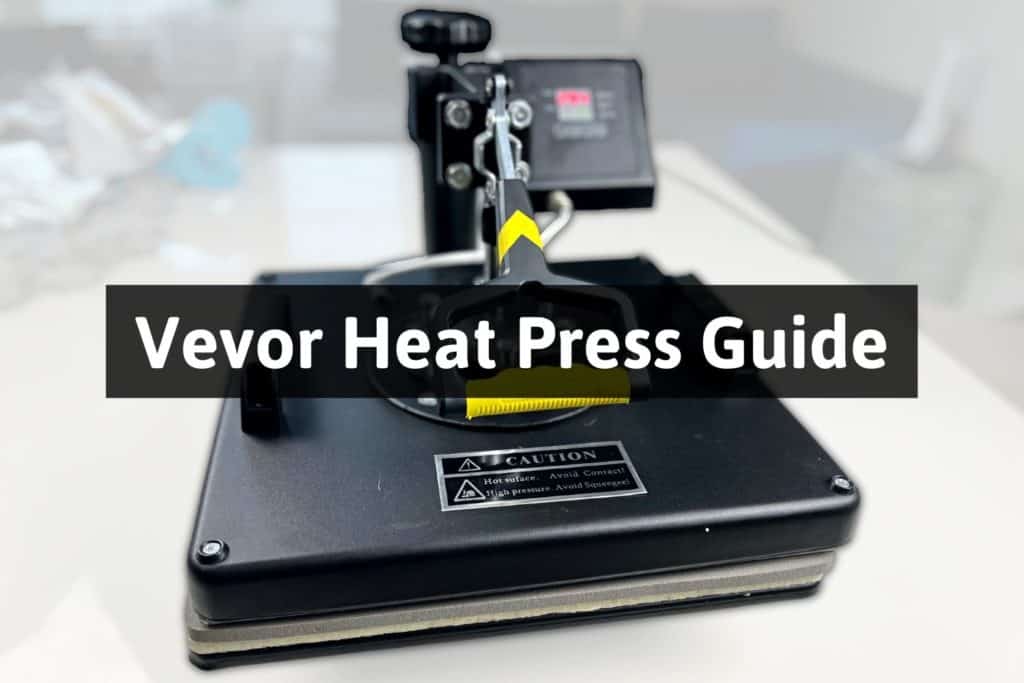
Vevor Heat Press Guide � The “Honest Truth” About This Budget Powerhouse

heat press machine with a yellow handle on a table with a blurry background. title reads "vevor heat press guide"

Table of Contents

Note: Some links in this post may contain affiliate links, which means at no cost to you, I may earn a commission.

The Honest Truth: Why Vevor Is the "No-Name" Giant

I frankly really like Vevor products because they make the “real thing” for a much lower price. If you look at their portable heat press, it looks almost identical to the Cricut EasyPress, but it’s hundreds of dollars cheaper. Vevor is essentially removing the brand name and the “brand tax” and giving you the same machine at a fraction of the cost. While they’re becoming a massive brand in their own right, they still offer that “no-name” value that makes professional-grade crafting accessible.

The Risks: Fire Safety and the "Crazy Hot" Reality

We first have to talk about safety. While I personally haven’t had any major mechanical failures, a friend of mine had a Vevor press that actually started a fire. You have to remember that these are high-draw electrical machines.

Another issue is that the entire machine gets crazy hot! There aren’t any “safe” places to touch other than the handle and the control buttons. If you’re used to the plastic, cool-to-the-touch casing of a Cricut EasyPress, this will be a shock. You have to be extremely careful not to brush your arm against the top or sides of the machine while you’re working.

The Swing-Away Struggle: Alignment and Shifting Fabric

The machine I use is a “swing-away” style (this one). In theory, this is great because you can move the heat source out of the way to set up your project. However, it is very difficult to get the top plate perfectly aligned over the bottom plate every single time.

The real danger here is when you’re trying to “eyeball” the alignment and adjust the heavy top plate, you’re likely to nudge your sublimation paper or cause your fabric to fold. In sublimation, any movement of the paper while it is hot will cause ghosting, and a fold in the fabric will lead to uneven pressure and faded sections. This constant need for adjustment makes the swinging motion a “one-way street” to a ruined project if you aren’t careful.

The Machine's Weight and Physical Demands

I’m going to be honest – I hate how heavy this machine is! It’s a solid piece of industrial equipment, and it’s not meant to be moved around frequently. If you don’t have a dedicated, permanent spot for it, the sheer weight will make every crafting session a chore.

This machine is NOT good for those with mobility issues. I’ve had periods where I struggled with mobility, and during those times, this machine was simply impossible for me to use. Between the heavy lifting and the force required to lock the handle at high pressure, it’s a physically demanding tool.

Furthermore, when you’re pressing at high pressure, the machine can become “unbalanced.” I have had some scary moments where the whole unit started tipping forward. If you aren’t physically able to manhandle it, it’s not the right machine for you and you’ll want to look at their automatic heat presses (which I love!).
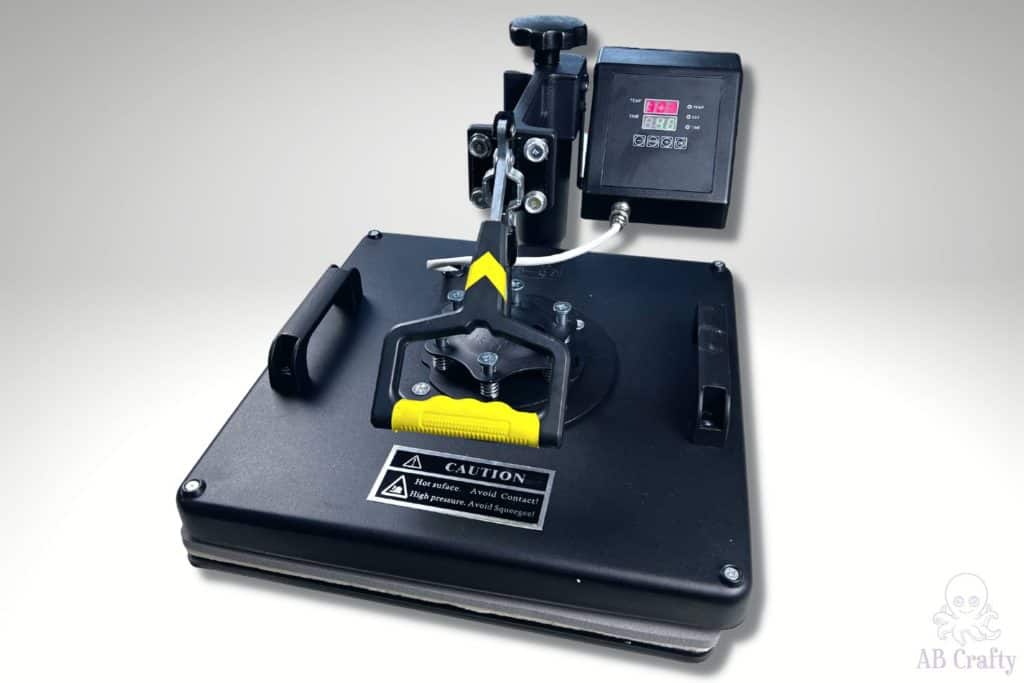
Performance: Heat-Up Times and Pressure Control

While I haven’t had any issues with uneven heat, this machine does take a long time to heat up. You can’t just flip it on and expect to press a shirt 30 seconds later. You have to plan ahead and let it sit.

The big advantage of this manual press over an automatic one is the pressure. I also own a Vevor automatic heat press, and while I like using it, this manual version is actually better for sublimation. You can really “crank” the pressure up to ensure the ink gasses into the fabric perfectly. It is more manual work, but the results are often more professional.

Don’t forget to pin it so you can easily come back to it later!
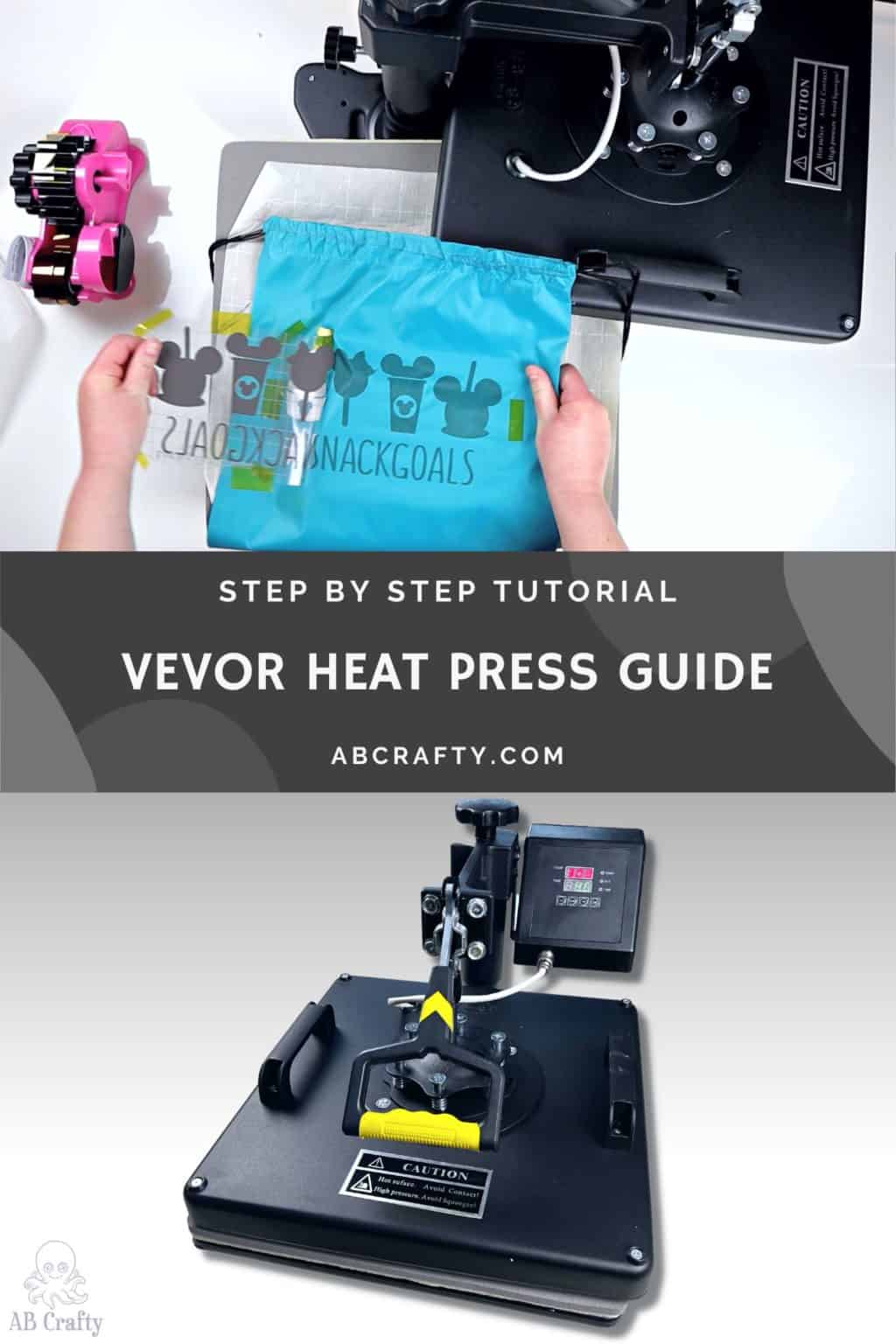
top image is pealing the sublimation design away from the drawstring bag to show the disney snack design on the bag and bottom image is the heat press. the title reads "step by step tutorial, vevor heat press guide, abcrafty.com"

Vevor Heat Press: Quick Settings Guide

Material Type Temp (F) Time (Seconds) Pressure Level
Sublimation (Polyester)
360° – 400°
40 – 60
High (Very Firm)
HTV (Cotton/Blends)
280° – 330°
10 – 30
Medium
HTV (Polyester)
270° – 300°
15-30
Medium
Transfer Paper (Inkjet)
350° – 375°
20-30
Medium

The “Honest Truth” Tip: These are general starting points. Because every brand of vinyl and ink is a little different, you should always check the instructions on your specific packaging to avoid a “one-way street” mistake.

Materials to Use a Vevor Heat Press

Step-by-Step: How to Use the Vevor Heat Press

1. Set the Temperature and Time

Start by placing the heat press on a sturdy table (this is the updated version of the press I have). This is not a machine you want on a flimsy folding table because it is incredibly heavy. Turn it on and determine your settings based on the materials you are using.

setting the temperature on the vevor heat press

To set the temperature, press the MODE button. The top number (TEMP) will start to flash. Use the + and buttons to adjust the starting temperature. Press MODE again to set the ending temperature. While the machine allows for two different temperatures, I have yet to do a project where they needed to be different. Press MODE one last time to set the TIME in seconds, and press MODE again to save.

For my project, since I was doing sublimation (using this black paper) on a shirt, I set the temperature to 365 degrees Fahrenheit and the timer to 40 seconds.

closeup of the vevor heat press settings with labels

2. Dial in the Pressure (The "Resistance Test")

While the machine is heating up, you have to set the pressure. This is a manual process using the knob at the top of the machine.

The Scientist Hack: Before the plate gets “crazy hot,” place the actual item you are going to press (like your shirt or blank) on the bottom plate. Close the handle. For sublimation, you want to feel a lot of resistance. If the handle closes too easily, turn the knob to the right to lower the plate and increase the pressure. If it is impossible to close, turn it to the left to raise the plate. You want it to feel firm and secure.

pointing to the knob that controls the pressure on the heat press

3. Prep Your Design

You can prepare your design while the machine warms up. Ensure you cut your design as a mirrored image. If you are using an image from the internet (this is the one I used for this project), it must be high resolution so the transfer does not come out blurry. Weed your design to remove any pieces that are not part of the final image.

disney snacks design in black sublimation paper already weeded

Get the latest DIY tutorials, reviews, and crafting updates

You'll never be spammed and can unsubscribe at any time

4. The Pressing Process

When the machine reaches the target temperature, it will give a few beeps.

  • Swing it Away: Use the handle to swing the upper plate to the side. Be extremely careful, as everything except the handles and buttons is “crazy hot” and will burn you instantly.

pushing the top of a swing heat press away, revealing the bottom plate
  • Protect the Plates: For sublimation, place a piece of parchment paper on the bottom plate. Place your item on top. If you are working with a shirt, put parchment paper inside the layers to prevent the ink from bleeding through.

  • Alignment and Tape: Position your design face down. It is difficult to get the plates perfectly centered, and if you have to keep adjusting the top plate, you might nudge the paper or fold the fabric. Use heat tape to secure the design so it does not shift.

taping down a disney snacks design from sublimation paper onto a blue drawstring bag using heat tape

The Lock Down: Place parchment paper on top and pull the handle all the way down. Press the START button. Be careful that the machine does not tip over when you apply force. I definitely recommend using the screw holes to secure it to your table if you can.

covering the drawstring bag and design with parchment paper on the heat press

Safety Tip!: Be careful that it also doesn’t tip over as you pull down on the level (especially at higher pressures)! There are screw holes to be able to secure it to the table so I definitely recommend doing so if you can.

Get the latest DIY tutorials, reviews, and crafting updates

You'll never be spammed and can unsubscribe at any time

using both hands to pull down the lever on the heat press

5. The Reveal and Cooling

Once the time is up, the machine will beep loudly. I am not a fan of the noise, so I usually press the START/PAUSE button a second before the timer ends. You can then lift the lever of the press and swing it away.

pushing the top of a swing heat press away, revealing the bottom plate with the pressed item, design, and parchment paper

Depending on the type of material you are using, you’ll want to peel off your design while it’s still warm or wait until it cools. For sublimation, you have to wait until it cools, as that is what sets the dyes.

Now your customized item is ready to use!

Get the latest DIY tutorials, reviews, and crafting updates

You'll never be spammed and can unsubscribe at any time

pealing the sublimation design away from the drawstring bag to show the disney snack design on the bag

What is a Vevor Heat Press?

A Vevor heat press is a professional-grade machine designed to apply heat and pressure to various materials for crafting. I like to think of Vevor as the “brand-less” alternative to more expensive companies. For example, the Vevor automatic heat press looks almost identical to the Cricut Autopress, but it is sold at a much lower price.

By removing the “brand tax,” Vevor allows crafters to get high-end equipment without paying for a famous name. While they are a major brand now, their goal is still to provide the “real thing” for less money. This specific model is a manual “swing-away” press, which gives you more control over the pressure than most automatic machines, making it a favorite for sublimation.

Materials to Use with a Vevor Heat Press

Because this machine can reach such high temperatures and high pressure, you can work with a wide variety of blanks:

  • Polyester Textiles: Sublimation shirts, tote bags, pillowcases, even stuffed animals
  • Hard Blanks: Ceramic tiles and mugs (if you are using the 5-in-1 attachments).
  • Metal: Aluminum signs, car plates, and keychains.
  • Wood: Most wood, but ideally  those specifically treated for sublimation
  • Heat Transfer Vinyl (HTV): Standard vinyl for cotton or blend shirts.

FAQs: The "Honest Truth" About Vevor

Is the Vevor heat press safe to use?

It’s a powerful machine that draws a lot of electricity. While mine has worked fine, we have to acknowledge that these are budget machines. A friend of mine had one start a fire, so you should never leave it unattended.

It’s also important to note that it gets extremely hot and can cause burns if you’re not careful. Therefore consider wearing long sleeves and heat protective gloves.

Why does the machine feel like it is going to tip over?

Because the top plate is so heavy, the machine can become unbalanced when you swing it away or when you apply high pressure. To prevent this, make sure you are working on a very sturdy, heavy table and screw it in.Because the top plate is so heavy, the machine can become unbalanced when you swing it away or when you apply high pressure. To prevent this, make sure you are working on a very sturdy, heavy table. I also highly recommend using the screw holes on the base to bolt the machine directly to your work surface. If it still feels unstable, you might need to use one hand to hold the base while you lock the handle with the other.

Can I use this if I have mobility issues?

Honestly, it is not good for those with mobility issues. It is extremely heavy and requires a lot of physical force. When I was having mobility issues, this machine was not something I was able to use.

How is the Vevor Heat Press different than using an iron?

The Vevor heat press machine provides way more benefits than using an iron when working with   iron-on vinyl or sublimation. Here are some of the key reasons why using a heat press is often recommended over an iron: 

  • Consistent and Continuous Pressure: A heat press provides consistent pressure, which is important for getting a good result. With an iron, it can be easy to apply too much or too little pressure, which can distort the image, not have it show up as vibrantly (in the case of sublimation), or cause it to peel off over time (in the case of transfer paper or vinyl). 
  • Set the Pressure: You can select the exact pressure on a heat press, making sure you’re using the correct amount of pressure for your materials. Additionally, it applies the pressure evenly.
  • Surface Area: A heat press has a wider area than an iron, making it faster and easier to press larger surfaces such as t-shirts.
  • Timer: A heat press has a built in timer so you can control how long you want to press your items.
  • Built in Surface: You don’t need an ironing board when using a Vevor heat press – another space saver!

What can I make with a Vevor Heat Press?

The possibilities are virtually endless with a Vevor heat press. You can make custom t-shirts, hats, mugs, tumblers, jewelry, aprons, bags, totes, labels, notebook covers, and more. Pretty much anything that you’d want to personalize or add a design to that won’t melt when heated, chances are you’ll be able to with a heat press.


Just keep in mind that for things such mugs or hats, you’ll need the specific attachments that come with the 5-in-1 kit. If you have the standard flat plate machine, you are limited to flat items like shirts, tote bags, or aluminum signs.

What kind of paper do you use on a Vevor Heat Press?

Ultimately, the type of paper depends on the project you are making.

  • Heat Transfer Paper: Allows you to print designs from a standard printer and transfer them to fabric.

  • Heat Transfer Vinyl (HTV): Best for cotton shirts and simple designs.

  • Sublimation Paper: Also known as infusible ink. This is what I use most. It actually dyes the fabric instead of sitting on top. Regardless of the project, you should always use parchment paper or a teflon sheet to protect the heat press plates from ink or glue.

How do you know which the temperature and time on a Vevor heat press?

TIt depends entirely on the material you are pressing. For standard iron-on vinyl on cotton, you will typically use 280-320 degrees Fahrenheit. For sublimation on polyester, you need a much higher temperature in the 360-400 degree range. Always check the packaging of your specific material for the exact “sweet spot.”As for time, the general rule of thumb is to press for 10-15 seconds on each side for vinyls and 40-60 seconds on the top for sublimation. However, this again will vary based on the material of the item and design.

How do you know how much pressure to use?

This is a “one-way street” with the Vevor. You have to use the manual knob at the top to adjust the height of the plate. For sublimation, you want “heavy” pressure, meaning it should feel like a struggle to lock the handle down. For standard vinyl, “medium” pressure is usually enough. I always recommend doing a “Resistance Test” with your actual item before you turn the heat on.

Conclusion: Is the Vevor Heat Press Worth It?

In my opinion, Vevor makes the “real thing” but without the brand name price. While this machine is more expensive than a Cricut EasyPress, it’s much cheaper than the Autopress. This specific machine is actually most comparable to the EasyPress because it provides the even, consistent pressure that you do not have to manually provide with your own body weight. You are essentially skipping the “brand tax” to get professional results.

However, as we have discussed, it’s a physically demanding machine. Between the weight, the “crazy hot” surfaces, and the scary “unbalanced” moments, it’s not for everyone. If you are physically able to handle the manual labor of a heavy press, the results are worth every penny. Just remember to check your alignment, use your heat tape, and keep an eye on the balance of the machine.

What to read next:

More How-To's and Craft Supply Guides

Get the latest DIY tutorials, reviews, and crafting updates

You'll never be spammed and can unsubscribe at any time

heat press machine with a yellow handle on a table with a blurry background. title reads "vevor heat press guide"

How to Use the Vevor Heat Pres

A complete guide to setting up and using the Vevor "swing-away" heat press. Learn how to dial in the manual pressure and avoid common safety risks.
Yield 1 Finished Sublimation Project
5 from 1 vote
Prep Time 15 minutes
Project Time 5 minutes
Total Time 20 minutes

Materials
  

  • Sublimation Blank (Shirt, Tote, etc.)
  • Design or Image
  • Sublimation Paper with mirrored design
  • Parchment Paper
  • Heat Tape

Equipment

  • 1 Vevor Heat Press
  • 1 Cricut optional
  • 1 Weeding Tool optional

Instructions
 

  • Turn the machine on and press the MODE button. Set your target temperature and time based on your material's packaging. (For sublimation, I use 365�F for 40 seconds).
    setting the temperature on the vevor heat press
  • The Resistance Test: While the plates are still warming up, place your item on the bottom plate and close the handle. It should feel like a struggle to lock it. Adjust the top knob until you feel high resistance.
    Sublimation Blank (Shirt, Tote, etc.)
    pointing to the knob that controls the pressure on the heat press
  • Prep and Mirror Your Design: While the machine reaches the target temperature, ensure your design is weeded and mirrored.
    Sublimation Paper with mirrored design, Design or Image
    disney snacks design in black sublimation paper already weeded
  • Protect the Plates: Place parchment paper on the bottom plate. Place your item on top. If you are using a shirt, put parchment paper inside the layers.
    Sublimation Blank (Shirt, Tote, etc.), Parchment Paper
    taping down a disney snacks design from sublimation paper onto a blue drawstring bag using heat tape
  • Secure with Heat Tape: Position your design face down and use heat tape so it does not shift when you move the swing-arm. Place another piece of parchment paper on top to protect your item.
    Parchment Paper, Heat Tape
    covering the drawstring bag and design with parchment paper on the heat press
  • Press and Lock: Swing the top plate back over your design and pull the handle all the way down. Press START.
    pulling down on the lever of the heat press and pressing the button for the timer
  • When the timer beeps, lift the handle and swing the plate away. Let the item cool completely before peeling the paper to ensure the dyes set properly.
    pealing the sublimation design away from the drawstring bag to show the disney snack design on the bag

Notes

  • Safety First: Never leave your press unattended while it's heating or in use. Because of the high electrical draw, it's best to plug it directly into a wall outlet rather than a power strip. This helps prevent the cord from getting "crazy hot" or causing a fire risk.
  • The Tip Hazard: Remember that this is a heavy, "top-heavy" machine. When you pull down on the handle, it can become unbalanced. You have to ensure it is bolted down or sitting on a very sturdy surface so it doesn't tip.
  • Alignment is Final: Sublimation is a "one-way street." Once those dyes are heated, you cannot undo the result. We have found that double-checking your alignment and using plenty of heat tape is the only way to avoid ghosting or ruined blanks.
  • The Resistance Test: If it's too easy to close the handle, your pressure is too low. For sublimation, it should feel like a real struggle to lock the handle into place.
Keyword Accessory, Clothing, Cricut, Heat Press, Heat Transfer Vinyl, HTV, Iron-On Vinyl, Sublimation, Transfer Paper, Vevor
Picture of Daniela Kretchmer

Daniela Kretchmer

Daniela is a lifelong crafter who loves to share her passion for crafting. Through classes or learning on her own, she likes to say she'll do pretty much any craft aside from scrapbooking. Her current personal obsessions include garden crafts, felting, and spinning yarn.

More Craft Projects and Ideas

  1. If i am sublimating do i need to use a pressing pillow inside shirt? If not what do i use inside shirt.,? Some people say teflon is not used when sublimation because if moisture then i see people attach it to the top if heat press can u tell me if thats ok to do. My top plate wobbles when i open it and dies not shut evenly how do i fix this

    1. With this heat press, no, you don’t need a pressing pillow since you control the amount of force being used. I like to use parchment paper inside as shown in this example both inside and on top.

      I’m not sure what you mean by a wobbling top plate and not shutting evenly. The top plate has the ability to move around so make sure it’s aligned over the bottom plate when pressing. Be sure to also set it to enough force to create firm pressure – especially when sublimating.

      1. How do you place the foam pads?
        Bottom plate, whole shirt, image ink-side down, parchment paper, both foam pads?

        (I am going to heat a print on both the front and the back of the shirt. I am using iron-on transfers on a cotton t-shirt).

        1. The foam pads are on the bottom, touching the bottom plate. So it’s bottom plate, then the white pad, then the grey foam pad. Then you do the shirt, image, parchment paper.

  2. I keep burning the material I am using… is there a Vevor guide I can follow for time and temperature I should be using for differentmaterials.. example the heat guide Cricut provides for their press.
    That would be so helpful and less frustrating

    Thank you
    ML Dube

    1. You want to follow the time and temperature for the materials you’re using and items you’re pressing. Regardless of the heat press you use, you’ll use the same temperature, time, and pressure based on materials.

  3. 5 stars
    Hi! What if we are doing both sides of a shirt?

    I did the front of my shirt using my Cricut press before I got the Vevor. I put the shirt face down on the orange foam piece. After pressing the back of my shirt, I have little orange pieces stuck in the design outlines on the front of the shirt. How do I avoid this? I can�t find instructions for dual-sided shirts

Leave a Comment

Your email address will not be published. Required fields are marked *

Rating