Can AI Write Crochet Patterns? Testing ChatGPT vs. Gemini

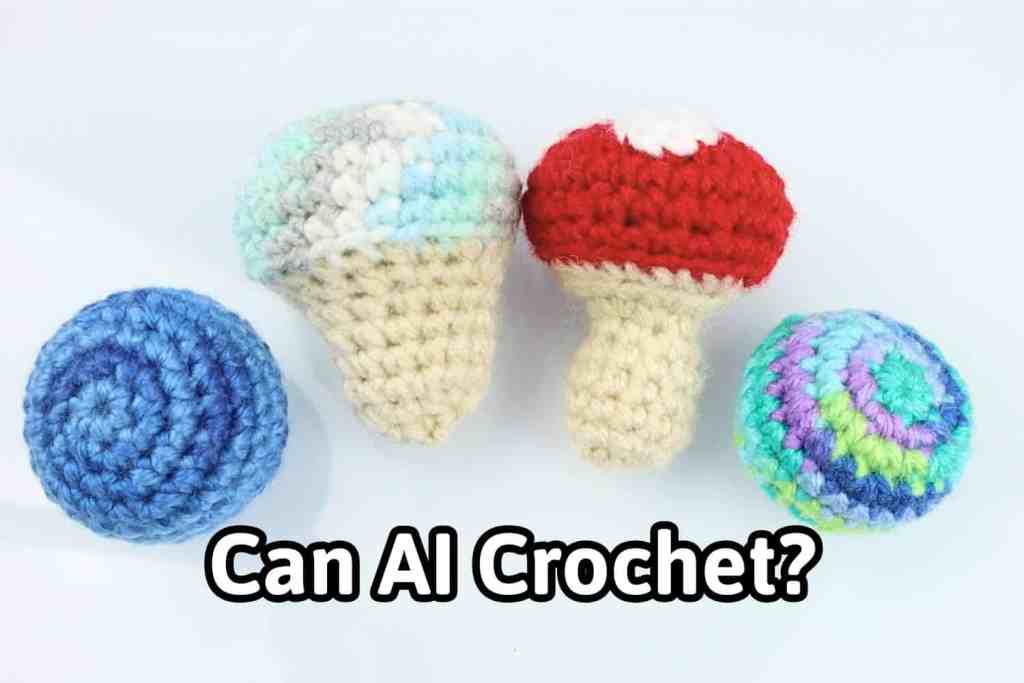
Flat lay photo of four finished AI crocheted items on a white background with white text reading "Can AI Crochet?" across the bottom center.

Generative AI models are everywhere, but can AI write functional crochet patterns? As someone who loves making amigurumi toys and works on fiber craft tutorials, like testing workspace accessories in my Yarn Bowl Guide, I wanted to see if plugging an idea into ChatGPT or Google Gemini could generate a workable pattern in seconds.

To test this, I pitted Google Gemini against ChatGPT using identical prompts to compare their reliability and see which AI is the better crafter.

Table of Contents

Note: Some links in this post may contain affiliate links, which means at no cost to you, I may earn a commission.

Get the latest DIY tutorials, reviews, and crafting updates

You'll never be spammed and can unsubscribe at any time

Don’t forget to pin it so you can easily come back to it later!

Vertical Pinterest pin graphic showing hands holding a round blue crochet sphere next to a flat multi-colored disc on top, a dark red center banner reading "Google Gemini vs ChatGPT: Can AI Crochet?", and hands holding two different crocheted mushrooms on the bottom.

Materials and Tools Used

Here are the supplies and tools I used for testing these AI patterns:

  • Digital Crochet Hook (Amazon): Great for keeping track of your row totals and stitch count math as you work. This has become my new favorite tool!
  • Stuffing (Amazon): Standard polyester fiberfill for shaping the amigurumi.
  • Catnip (Amazon): Added to the center of the balls and mushrooms for the cat toy test. It’s the same one I used for my needle felted cat toys.
  • Yarns: Worsted weight yarn in these colorways: Blue Variegated (this is similar), Blue/Green/Purple Multi-color, Cream (Michael’s), Blue/Grey Multi-color (Michael’s), Red, and White
  • Yarn Needle: Used for weaving in ends, embroidering white spots, and sewing pieces together.
  • Google Gemini and ChatGPT: Free AI models used to generate the pattern prompts.

Test 1: AI Crochet Pattern for a Basic Ball

For the first test, I started simple with a basic sphere that would be turned into a cat toy. Testing a simple 3D shape reveals whether an AI model understands basic spatial math and row height.

The Prompt Used

Create a crochet pattern with row by row instructions and total stitch count for each row at the end. Make it for a circular cat toy

Then the outputs were lengthy and weren’t an easy-to-read pattern so I had them reformat them and added this:

Simplify the instructions so that the format for the first rows would look like this: 1. Sc 6 into a magic ring (6) 2. Inc x6 (12) 3. (1 sc, 1 inc)x6 (18)

The Pattern Outputs

Google Gemini Output (Circular Cat Toy)

Here is the streamlined pattern with the row-by-row format you requested.

  1. Sc 6 into a magic ring (6)
  2. Inc x6 (12)
  3. (1 sc, 1 inc) x6 (18)
  4. (2 sc, 1 inc) x6 (24)
  5. Sc 24 (24)
  6. Sc 24 (24)
  7. Sc 24 (24)
  8. Sc 24 (24)
  9. (2 sc, 1 dec) x6 (18) — Add stuffing and catnip/bell here
  10. (1 sc, 1 dec) x6 (12)
  11. Dec x6 (6)

To finish, cut the yarn leaving a short tail, weave it through the front loops of the last 6 stitches, pull tight to close, and knot securely.

ChatGPT Output (Circular Cat Toy)

Simple Circular Cat Toy

Work in continuous rounds. Use a stitch marker to mark the beginning of each round.

  1. Sc 6 into a magic ring (6)
  2. Inc ×6 (12)
  3. (1 sc, 1 inc) ×6 (18)
  4. (2 sc, 1 inc) ×6 (24)
  5. Sc around (24)
  6. Sc around (24)
  7. (2 sc, 1 dec) ×6 (18)
    • Stuff the toy with fiberfill (and catnip if desired).
  8. (1 sc, 1 dec) ×6 (12)
    • Add more stuffing if needed.
  9. Dec ×6 (6)
    • Fasten off, thread the yarn through the remaining stitches, pull tight, and weave in the end securely.
Hands crocheting a small blue circle using a purple row and stitch counting crochet hook.

How the Builds Went

The difference between these two patterns comes down to the middle section. Gemini’s pattern included 4 repeat rows of 24 stitches, which gave the piece enough height to form a true sphere.

ChatGPT’s pattern only included 2 middle rows of 24 stitches. Because it skipped those critical middle rows, the shape turned out very flat. It looked more like a macaron or a coin pocket than a ball.

Test 1 Results

Gemini created a functional, spherical ball. ChatGPT failed to create a sphere due to missing middle rows.

Hands holding a round blue crocheted ball next to a flat multi-colored crocheted disc for a comparison test
Feature / Metric Google Gemini (Ball Test) ChatGPT (Ball Test)
Total Rows
11 rows
9 rows
Middle Section
4 rows of 24 stitches
2 rows of 24 stitches
Stitch Count Math
Accurate row totals
Accurate row totals, but too few rows
Increase/Decrease Logic
Correct standard sphere progression
Correct progression, but cut off early
Stuffing / Catnip Prompt
Included at row 9
Included at row 7
Final Shape
Spherical ball
Flat, macaron-like shape
Result
Pass
Fail

Get the latest DIY tutorials, reviews, and crafting updates

You'll never be spammed and can unsubscribe at any time

Test 2: AI Crochet Mushroom Pattern Test

For round two, I stepped up the difficulty to a mushroom. Mushrooms require color changes, taper shaping, and assembling separate components.

The Prompt Used

Now create a pattern for a mushroom

The Pattern Outputs

Google Gemini Output (Mushroom)

Here is a simple, streamlined pattern for a mushroom cat toy. It is worked in continuous rounds from the top of the cap down to the base of the stem so it is all one piece.

Mushroom Cap (Start in Red or Cap Color)

1. Sc 6 into a magic ring (6)
2. Inc x6 (12)
3. (1 sc, 1 inc) x6 (18)
4. (2 sc, 1 inc) x6 (24)
5. (3 sc, 1 inc) x6 (30)
6. Sc 30 (30)
7. Sc 30 (30)
8. Sc 30 (30)

Mushroom Stem (Change to White or Cream)

9. In back loops only, (1 sc, 1 dec) x10 (20)
10. (2 sc, 1 dec) x5 (15)
11. Sc 15 (15)
12. Sc 15 (15) — Stuff the cap firmly and add catnip here
13. Sc 15 (15)
14. Sc 15 (15)
15. (1 sc, 1 dec) x5 (10) — Stuff the stem firmly
16. Dec x5 (5)

To finish, cut the yarn, weave it through the front loops of the last 5 stitches, pull tight to close, and knot securely. If you want to add the classic white spots to the cap, you can use a yarn needle and a bit of white yarn to stitch a few French knots or simple straight stitches around the top.

ChatGPT Output (Mushroom)

Crochet Mushroom

Work the cap and stem separately, then sew them together.

Cap

  1. Sc 6 into a magic ring (6)
  2. Inc ×6 (12)
  3. (1 sc, 1 inc) ×6 (18)
  4. (2 sc, 1 inc) ×6 (24)
  5. (3 sc, 1 inc) ×6 (30)
  6. Sc around (30)
  7. (3 sc, 1 dec) ×6 (24)
  8. Sc around (24)
    • Fasten off, leaving a long tail for sewing.

Stem

  1. Sc 6 into a magic ring (6)
  2. Inc ×6 (12)
  3. Sc around (12)
  4. Sc around (12)
  5. Sc around (12)
  6. (1 sc, 1 dec) ×4 (8)
  7. Sc around (8)
    • Stuff the stem lightly.
  8. Inc ×8 (16)
  9. Sc around (16)
    • Fasten off, leaving a long tail.

Assembly

  • Stuff the cap lightly.
  • Sew the stem to the center of the underside of the cap.
  • Weave in all ends.

Optional Spots (make 3–6)

  1. Sc 6 into a magic ring (6)
  2. Sl st to first stitch, fasten off.

Sew the spots evenly around the top of the cap for a classic toadstool look.

Close up of a smartphone displaying AI crochet pattern instructions next to a light blue crocheted mushroom.

How the Builds Went

Gemini had a clever idea by making the mushroom a continuous piece and working in the back loops to transition from cap to stem. However, it didn’t come in enough and the stem wasn’t narrow enough. Instead of looking like a mushroom, the finished shape looked more like a doorknob.

ChatGPT created a much better shape with a bulbous base on the stem and more narrow stem. However, the assembly math was broken. The cap ended with 30 stitches while the top of the stem ended with 16 stitches. ChatGPT provided no explanation for how to attach a 16-stitch opening to a 30-stitch opening. I had to manually work two cap stitches to every one stem stitch to make them join. It also instructed leaving long tails on both pieces without clarifying which color yarn to use for sewing.

Test 2 Results

Gemini’s mushroom failed on proportions and the result wasn’t even recognizable as a mushroom.

ChatGPT produced the more recognizable mushroom shape, even though the assembly instructions required manual adjustments. Therefore overall, it still did not succeed.

Hands holding two completed AI crocheted mushrooms side-by-side, comparing a light blue doorknob-shaped mushroom and a classic red and white mushroom.
Feature / Metric Google Gemini (Mushroom Test) ChatGPT (Mushroom Test)
Construction Method
One continuous piece
Two separate pieces (cap and stem)
Context Awareness (Cat Toy)
Yes (retained thread context and included catnip instructions)
No (forgot thread context and didn’t make it a cat toy)
Stitch Count Math
Accurate row totals throughout
Accurate within individual pieces, but failed on assembly math (30 cap vs 16 stem)
Increase/Decrease Logic
Clever BLO transition, but lacked stem tapering logic
Good stem shaping logic, but missing strategy to join mismatched counts
Color Changes
Seamless transition to stem
Separate pieces worked in red and white
Assembly Logic
No sewing required
Required joining 16 stem stitches to 30 cap stitches manually
Special Details
Recommended embroidered French knot spots
Suggested optional white spots
Final Shape
Doorknob shape
Recognizable mushroom shape
Result
Fail
Fail

Common AI Crochet Pattern Fails and Glitches

Testing these AI crochet pattern generators revealed several repeating glitches:

  • Stitch Count Mismatches: AI models struggle with spatial math, generating pieces with mismatched stitch counts when joining parts.
  • Proportional Distortion: Skipping necessary repeat rows causes 3D shapes to flatten into discs or extend into straight cylinders.
  • Unclear Assembly: One didn’t provide details on how to change colors, while the other had me leave long tails for both colors, making it unclear which I was to use for sewing.
  • Missing Flipping Steps: AI patterns rarely remind you to turn amigurumi right-side out before stuffing, which can lead to inside-out seams.
  • Timing of Stuffing is Awkward: It seems to arbitrarily chooses when the stuffing should be added, making it difficult to either get the stuffing in or continue to crochet around it.
  • Forgets Chat Thread: It’s likely it won’t remember what you previously chatted about, causing some instructions (ie. adding catnip) to be left out.
Flat lay photo of four finished AI crocheted projects arranged on a white background, including a round blue ball, two different mushrooms, and a flat multi-colored disc.

Is AI Ready to Generate Crochet Patterns?

It is technically possible for AI to create a successful crochet pattern, as we saw with Gemini generating a proper ball. However, across all four patterns tested, we only had one true success.

While a generated pattern might look completely correct on paper because AI seems to understand basic increases and decreases, stepping up to a simple amigurumi mushroom tripped up both models.

Ideally, an experienced crafter could scour a pattern beforehand, spot structural flaws, and make on-the-fly math adjustments. But for me, I had to physically crochet each item from start to finish just to learn it didn’t work out. AI still has a long way to go before it becomes a truly reliable tool for crafters. If you’re looking for yarn tools or fiber craft tutorials that deliver reliable results on the first try, check out my Sentro Knitting Machine Reversible Hat Guide or my roundup of the Best Knitting and Crochet Gifts.

More Fiber Crafts and Inspiration

Picture of Daniela

Daniela

Daniela is a lifelong crafter who loves to share her passion for crafting. Through classes or learning on her own, she likes to say she'll do pretty much any craft aside from scrapbooking. Her current personal obsessions include garden crafts, felting, and spinning yarn.

More Craft Projects and Ideas

Leave a Comment

Your email address will not be published. Required fields are marked *