Discover how to dye wool roving using Jacquard Acid Dyes, including their neon set that glows under blacklight. Follow this beginner-friendly step-by-step tutorial to create vibrant, UV-reactive fiber perfect for spinning or felting.
Table of Contents
If you’ve been curious about how to dye wool but feel intimidated by the process—don’t worry! This is the quick and easy (aka lazy crafter-approved) way to do it. Whether you’re prepping fiber for spinning or felting, this tutorial shows you how to get bright, professional results with minimal effort.
And for an extra bonus? The dyes I used glow under blacklight!
Note: Some links in this post may contain affiliate links, which means at no cost to you, I may earn a commission.
Get the latest DIY tutorials, reviews, and crafting updates
You'll never be spammed and can unsubscribe at any time
What Are Jacquard Acid Dyes?
First off, Jacquard is a brand that makes a lot of products in the dyeing space and one of their lines includes acid dyes.
Therefore Jacquard Acid Dyes are dyes to be used on wool, silk, and other protein fibers. Despite the name, they’re not acidic on their own—the “acid” refers to the mild acid (usually vinegar or citric acid) used during the dyeing process.
The Jacquard acid dye instructions are pretty straightforward, making them great for both beginners and experienced fiber artists.
Jacquard Coupon Code
Use code ABCRAFTY to get 20% off your order at Jacquard! This code works for their full line of acid dyes and more. It’s the perfect excuse to try out their glowing neon colors (find them here).
Don’t forget to pin it so you can easily come back to it later!
Materials for Dyeing Wool
- Wool Roving (I used this type, which is undyed 22 micron merino wool)
- Jacquard Acid Dyes (I used their neon line – use code ABCRAFTY for 20% off at Jacquard– in case the set is sold out you can also get individual colors here)
- Vinegar or Citric Acid (in case it’s sold out, you can also get it on Amazon)
- Squeeze Bottles (these are similar to mine)
- Food Scale (this is the one I have)
- Electric Skillet (this is the one I have)
- Synthrapol (use code ABCRAFTY for 20% off at Jacquard)
- Spin Dryer (optional, but highly recommended if you do a lot of dyeing projects – the one I have no longer exists, but this one is similar)
- Respirator
- Gloves
In case Jacquard is sold out of their neon acid dye set, you can get the individual colors, linked below:
Video Instructions
Instructions to Dye Wool Roving with Jacquard Acid Dyes
Prep the Wool
Mix some vinegar with room temperature water. I don’t really measure it (we’re going lazy way, remember!), but if I were to guess it’s probably about 1/8th of a cup of vinegar to 1 gallon of water. Another option is to use citric acid instead of vinegar (you can get the citric acid here for 20% off with code ABCRAFTY).
Let the wool completely soak into the vinegar solution (I used around 4 oz of 22 micron merino wool, which you can get here). When it’s fully submerged let it soak for 1 hour. This helps prep the wool for the acid dye and allows the dye to more easily flow through the layers of the wool.
Tip: Ideally you’d let the wool soak in on it’s own, but I’m impatient so I push it in. Just know that this can cause felting.
Prepare the Acid Dyes
This dye set I’m using includes six colors: Blacklight Blue, Fluorescent Red, Orange, Yellow, Chartreuse, and Hot Pink (you can get it here for 20% off with code ABCRAFTY. In case the set is sold out, you can also get the colors individually here)
Unless stated otherwise, you’ll prepare any Jacquard acid dye the same way.
Before anything, put on a respirator since the dye is made up of small particles!
Use a bottle with measurements on the side and put it on the scale (these are similar to the bottles I have). Then hit tare.
The usual ratio is 1 gram of dye per 100ml of water. I planned to make 200ml, so I needed 2 grams.
Then fill the bottle to 200ml with hot water (I use the lowest setting on an electric kettle).
Tip: To help prevent a mess, fill the bottle only part way and then dissolve the dye. Once the acid dye is completely dissolved, fill the bottle the rest of the way.
Tip #2: Use painters tape and a sharpie to label each bottle.
Get the latest DIY tutorials, reviews, and crafting updates
You'll never be spammed and can unsubscribe at any time
Dye the Wool
Aside from the acid, the other thing acid dyes need to set is heat. Therefore the easiest way to dye the wool is directly in an electric skillet that will be used to heat and set the dye (this is the one I have).
Remove the wool from the vinegar solution and snake it into the skillet, removing the majority of the liquid as you go.
Tip: Tilt the pan to even out the excess moisture. Having a little bit of excess can be helpful so that the liquid doesn’t completely evaporate and burn.
Note: The pan should not be used for food – after using it for dye it is no longer food safe!
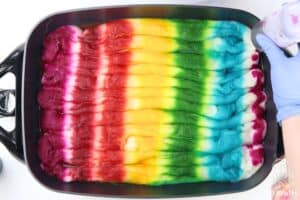
I opted for a rainbow pattern using all of the Jacquard neon acid dyes, but now’s the time to add the dye however you’d like.
I went in order and made stripes of each color, but since there isn’t a purple I mixed the pink and blue at the end by smooshing it gently with my finger to combine them.
I have also dyed wool by doing random bloches of different colors so now is your time to be creative!
To make sure there is enough dye, lift up the sides and check between the folds. This also helps the dye soak through from underneath.
You want to make sure the dye fully saturates the wool.
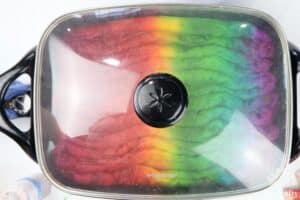
Cover the skillet and set it to warm or slightly higher. You want it to be just barely simmering.
Let it “cook” for 1 hour or until all of the dye has been absorbed.
Once it’s done, let it sit to cool on its own completely. Wool is especially sensitive while it’s hot as heat and agitation cause felting, so be careful not to mess with it!
Wash and Dry the Dyed Wool
After the wool is cooled, transfer it to a bowl of room temperature water and add a splash of Synthrapol (get it from Jacquard for 20% off with code ABCRAFTY). This is my absolute favorite new soap for dyeing -it works so well at pulling out excess dye.
Barely agitate the wool, trying to be as gentle as possible. Then drain the water, add new water and repeat the rinsing until it runs clear.
Now it’s time to dry the wool! I cannot recommend a spin dryer enough for this process. The one I have doesn’t seem to be sold anymore, but this one is similar.
All you need to do is plop the wool into the dryer, spread it evenly, close it, and turn it on. Then the water comes out the bottom and after ~30 seconds you’re left with wool that is 80-90% dry.
Get the latest DIY tutorials, reviews, and crafting updates
You'll never be spammed and can unsubscribe at any time
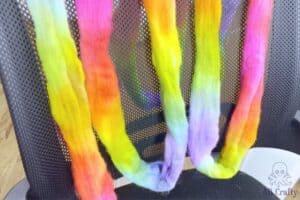
Then leave the dyed wool to dry completely. I like to drape it over a chair overnight.
You can see the edges felted a little, but nothing too bad. I recommend fluffing the fibers to separate them and prep them for use.
Just look at how these came out! The neon colors really are neon!
And under a blacklight? My goodness! It’s just too cool!
If you want to try these Jacquard acid dyes for yourself, don’t forget to use code ABCRAFTY for 20% off!
Get the latest DIY tutorials, reviews, and crafting updates
You'll never be spammed and can unsubscribe at any time
Frequently Asked Questions
What are acid dyes used for?
Acid dyes are used to dye protein fibers such as wool and silk (fibers that come from an animal). They require heat and acid to set the dye, hence the name “acid dyes.”
Can I use Jacquard acid dyes on cotton or synthetic fibers?
No, Jacquard acid dyes are specifically formulated for protein fibers. For cotton or plant-based fabrics, you’ll want to use what’s called a fiber-reactive dye instead (such as these which you can get for 20% off with code ABCRAFTY). Under the Jacquard brand they’re also known as the Procion MX line.
Do I need special equipment to dye wool with acid dyes?
Nope! Just a heat source such as a skillet or pan/stove, vinegar or citric acid, a scale, and something to apply the dye.
Just make sure that whatever you’re “cooking” it in is not then used for food.
How much water should I use for 1 gram of acid dye powder?
As a general rule of thumb, you want to use 100ml per 1 gram of acid dye powder.
Do the Jacquard neon acid dyes really glow under blacklight?
Yes! Jacquard’s line of neon acid dyes glow under a blacklight! Each color glows a different color. These are the only acid dyes that Jacquard has made that glow under a blacklight.
You can get the whole set here for 20% off with code ABCRAFTY! And in case the set is sold out, you can get the individual colors here as well.
Can you mix acid dyes?
Yes! You can absolutely mix acid dyes to make new colors. I recommend first dissolving the dye into water and then using the ready-dyes to make new colors. I mixed the fluorescent blue dye with fuschia pink to make purple.
More Crafts to Try
Get the latest DIY tutorials, reviews, and crafting updates
You'll never be spammed and can unsubscribe at any time

How to Dye Wool Roving with Jacquard Acid Dyes (Quick & Easy Method)
Materials
- Jacquard Acid Dyes
- Wool Roving
- Vinegar or Citric Acid
- Synthrapol
Equipment
- Electric Skillet
- Bottles with Measurements
- Food Scale
- Spin Dryer optional
- Respirator
Instructions
- Soak the wool roving in warm water with a splash of vinegar for at least 1 hour. This preps the fibers to absorb the dye.Vinegar or Citric Acid, Wool Roving
- Put on a respirator. Mix your Jacquard acid dye powders using 1gm of dye to 100ml of hot water. You can get the dyes for 20% using code ABCRAFTYJacquard Acid Dyes
- Place the wool into the electric skillet, removing most of the liquid. Use squeeze bottles or cups to gently apply the dye to the wool in rainbow order or your preferred design. Avoid overhandling to prevent felting.
- Cover the wool, set it to warm or until it's just barely simmering. Cook for 1 hour or until the dye has soaked in.
- Let the wool cool completely on it's own. Then move it to a bowl with a little bit of synthrapol and carefully wash it. Then rinse until the water runs clear.Synthrapol
- Place the wool into a spin dryer to dry 80-90% of the way. Then hang it over a chair to dry overnight.